NextGreen uses Reflexive Monitoring for working groups
To monitor progress and adjust complex transition processes, NextGreen uses Reflexive Monitoring in Action (RMA). This proven methodology, which includes practical tools, ensures collective learning and enables participants to collaboratively refine their approach to transition challenges.
What is Reflexive Monitoring in Action (RMA)?
RMA is a proven methodology for facilitating ongoing learning, reflection, and course correction in complex transition challenges. It is not a blueprint, but a way of thinking and viewing the world that drives systemic change.
A systemic transition is far-reaching and affects how a society is organized—from the economy to culture and nature. It is often a long-term and unpredictable process. At NextGreen, we are working toward a resilient planet for the present and the future. To this end, we facilitate multi-year processes with groups of participants from various organizations, ranging from governments and land management organizations to businesses and financial institutions.
To maintain an overview and focus on the system transition in such projects, and to facilitate learning and course correction by participants, we use Reflexive Monitoring in Action (RMA). This methodology was developed to support long-term, complex projects and initiatives focused on system transition. To facilitate this complex process, practical tools have been developed, such as System Analysis or the Dynamic Learning Agenda (DLA). Using these tools, we help projects, processes, and programs analyze their place within the broader transition and gain insight into the relevant stakeholders in the transition. The method also provides space for reflection and course correction within processes, and helps identify bottlenecks, priorities, and next steps.
Collective learning within the Climate Adaptation Community of Practice: Green Solutions from and with Nature
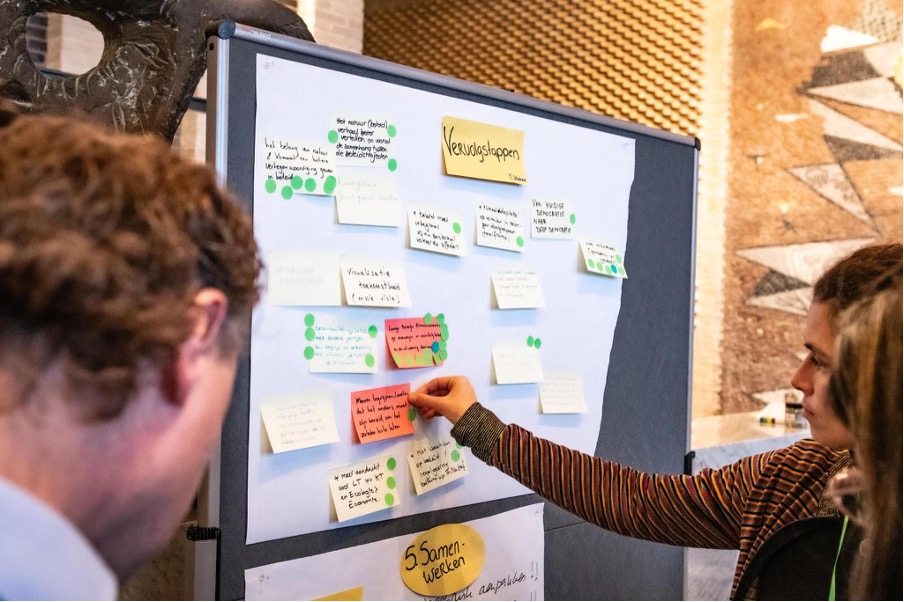
One of the working groups in which we collaborate with RMA is the Community of Practice on Climate Adaptation and Nature (CoP KAN). The Adaptation Atelier and the Ministry of Agriculture, Nature and Food Quality (LVVN) are organizing this CoP from 2025 to 2027. Governments and land management organizations share their experiences and activities related to climate adaptation through and with nature. To maintain an overview and focus on system transition, NextGreen introduced the Dynamic Learning Agenda (DLA). We translated the lessons, insights, opportunities, and bottlenecks into learning questions—that is, questions that reflect on existing ways of thinking, working, and organizing. In subgroups with participants, we identified the answers found so far for each theme and determined the actions needed to address the remaining learning questions.
Joint Development Agenda
The community then turned this into its own “Development Agenda,” which served as the basis for the subsequent meetings and workshop. This allowed them to invite specific parties or raise the outstanding questions with other organizations. By systematically reflecting together on completed actions, new lessons and insights can emerge that form the basis for new learning questions. The joint Development Agenda helps to effectively monitor this process together and build on the content in a targeted manner.
Work Landscapes of the Future
Work Landscapes of the Future (WvdT) is working to transform the more than 3,000 industrial parks in the Netherlands on a large scale. WvdT aims to make developed industrial parks in the Netherlands greener, thereby making them more climate-resilient and healthier. As part of this major undertaking, NextGreen is also collaborating with RMA. The method is used to monitor the program, contribute to the collective learning process, and thereby help accelerate the transition. The methodology is integrated as much as possible into existing processes within the program and developed through co-creation and dialogue with parties within the coalition. In this way, we build support and gain insights to accelerate the transition together.